

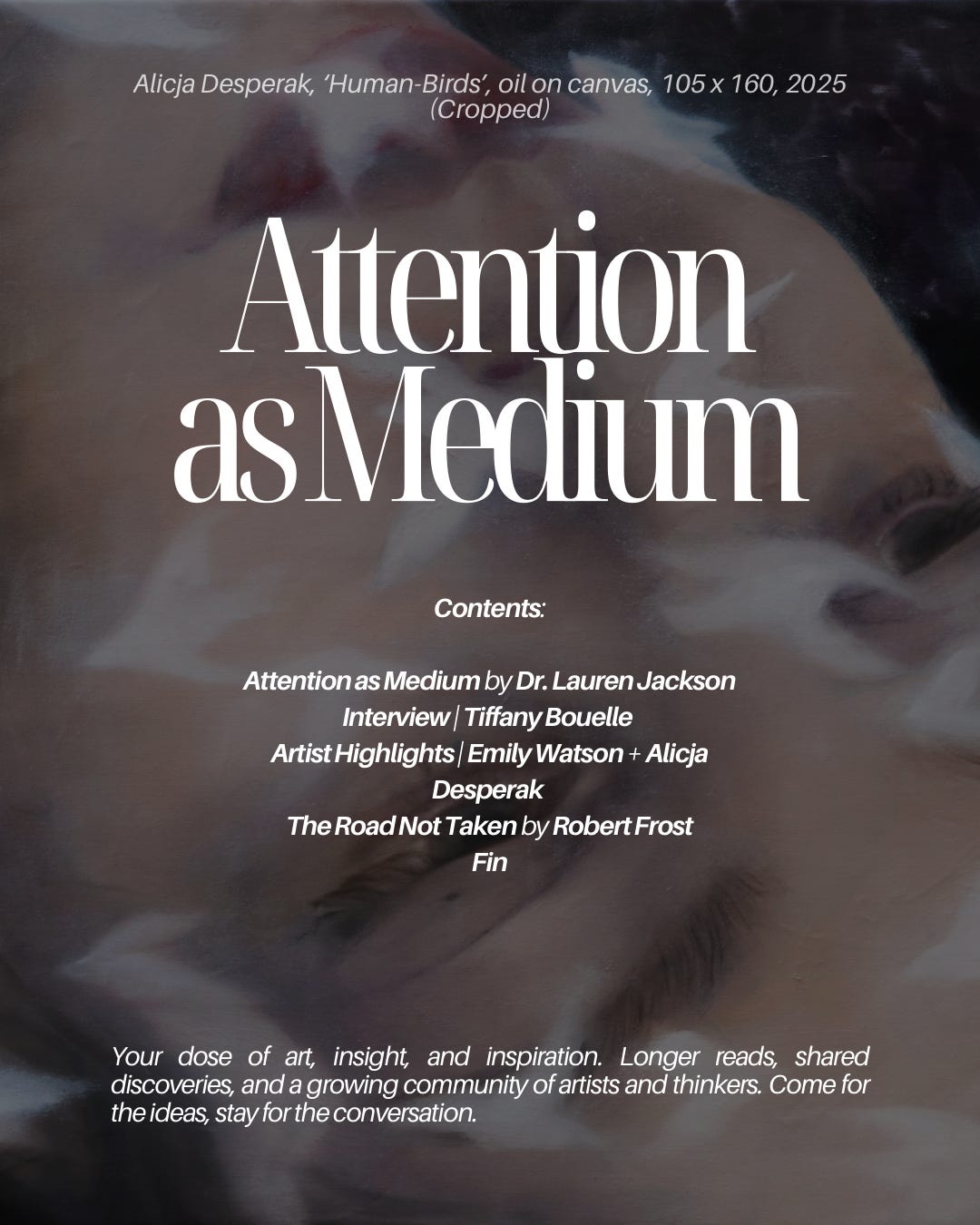
Attention as Medium
Attention as Medium by Dr. Lauren Jackson | Interview with Tiffany Bouelle | Artist Highlights - Emily Watson + Alicja Desperak | The Road Not Taken by Robert Frost


Attention as Medium
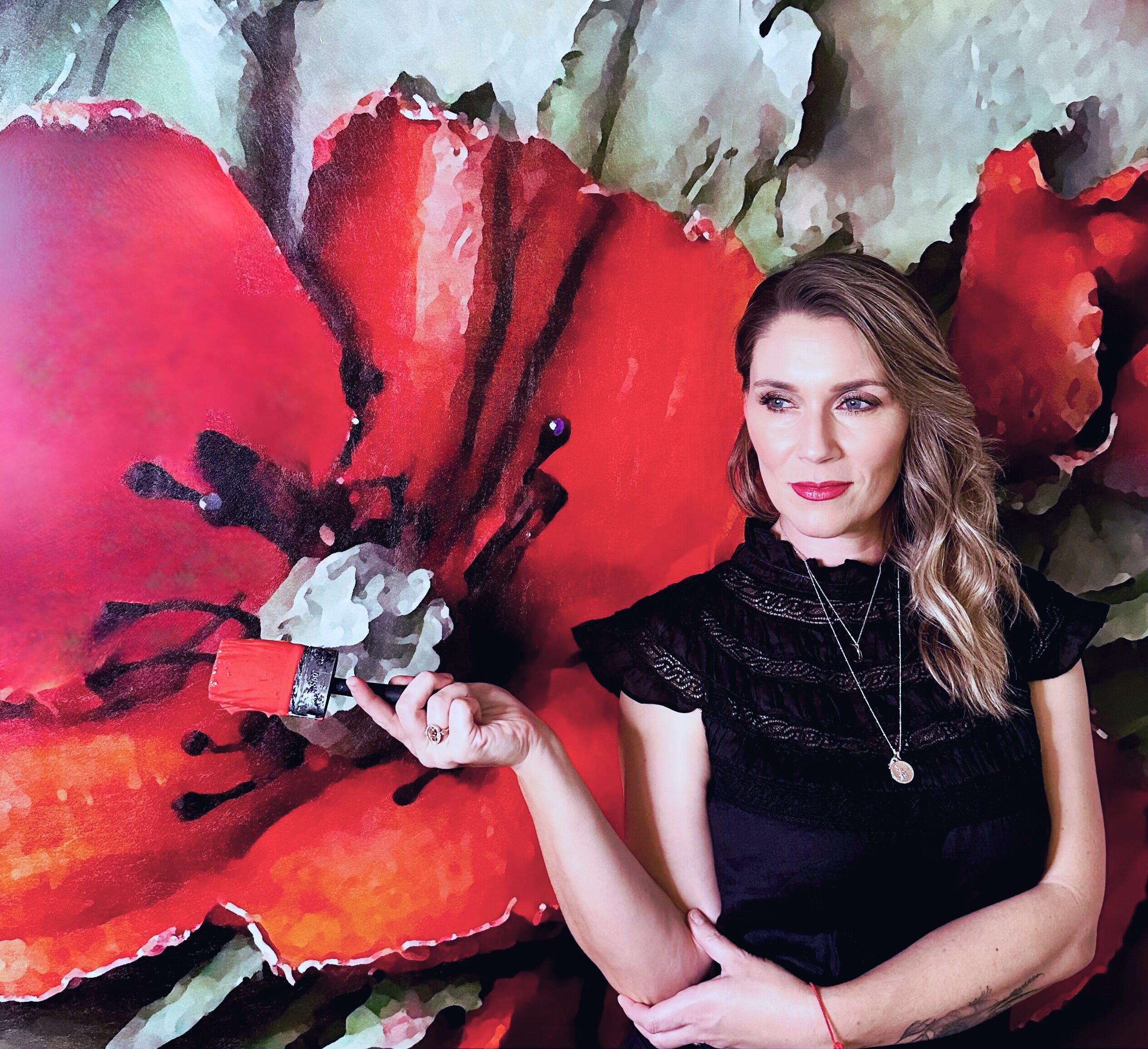
Psychologist | Mixed Media Artist | Translating the Artist Experience Through Behavioral Science & Neuroscience
I’ve lost more creative energy to “almost-starting” than to any true lack of inspiration: the half-clean studio, the phone buzzing, family calling for my attention—someone inevitably asking for a snack—and the mental list running underneath everything like a low hum. On those days, it isn’t ideas I’m missing—it’s room. The simplest acts—clearing a surface, turning down the noise, building structures that can auto-pilot what doesn’t need my direct energy—can feel less like chores and more like opening a channel.
But this only happens if we’re willing to protect our creativity and be purposeful about the mundane aspects of our lives.
William Butler Yeats named this dynamic with quiet precision: “The world is full of magic things, patiently waiting for our senses to grow sharper.” If that’s true, creativity isn’t only a matter of making—it’s a matter of perceiving. And the unfortunate reality of being human is this: perception has human limits, with human conditions.
Perception, not production
When we talk about the artist, we often talk about output: style, technique, voice. But voice is, and always will be, downstream from attention. What you notice repeatedly becomes what you make repeatedly. What you cannot hear—because your inner world is too crowded and your outer world is too loud—never makes it to the page or the canvas.
Simone Weil put it starkly: “Attention is the rarest and purest form of generosity.” For artists, that generosity isn’t only toward others. It’s toward the work itself—the willingness to prioritize the inner and outer conditions that allow the work to be realized.
In other words, the work doesn’t start when you sit down at your table to create. It starts long before that. It starts in the quiet spaces: dreamscapes, inner dialogue, the small self-realizations that only surface when we give ourselves enough room to reflect. This kind of inner exploration takes time and space. It’s how the darker corners of the artist psyche—what we avoid, suppress, or rush past—eventually translate into something coherent and alive in exterior creative expression.
Your life is your operating system
This is where “life as art” becomes practical. The choices you make—how you spend time, money, and energy; what you tolerate; what you invite into your life—aren’t separate from your creative practice. They’re the background settings of the instrument you’re playing.
Annie Dillard once said: “How we spend our days is, of course, how we spend our lives.” This line is a call to recognize that our days are not neutral. They are training. They teach our nervous system what to expect. They teach our mind what kind of depth is available.

 | A guest post by
|